 The Occultation Group at UVA
About Our Research
Our Mission
The Occultation Group is an undergraduate research group at UVA which specializes in observing stellar occultations by Solar System bodies. These occultations occur when an asteroid, dwarf planet, or planet passes in front of a distant star, casting a shadow across Earth—just like an eclipse! These thin shadows sweep across continents, but are rarely more than a handful of kilometers wide. Stellar occultations provide the most precise measurements on asteroid position, shape, and size which can be gathered from the surface of the Earth.
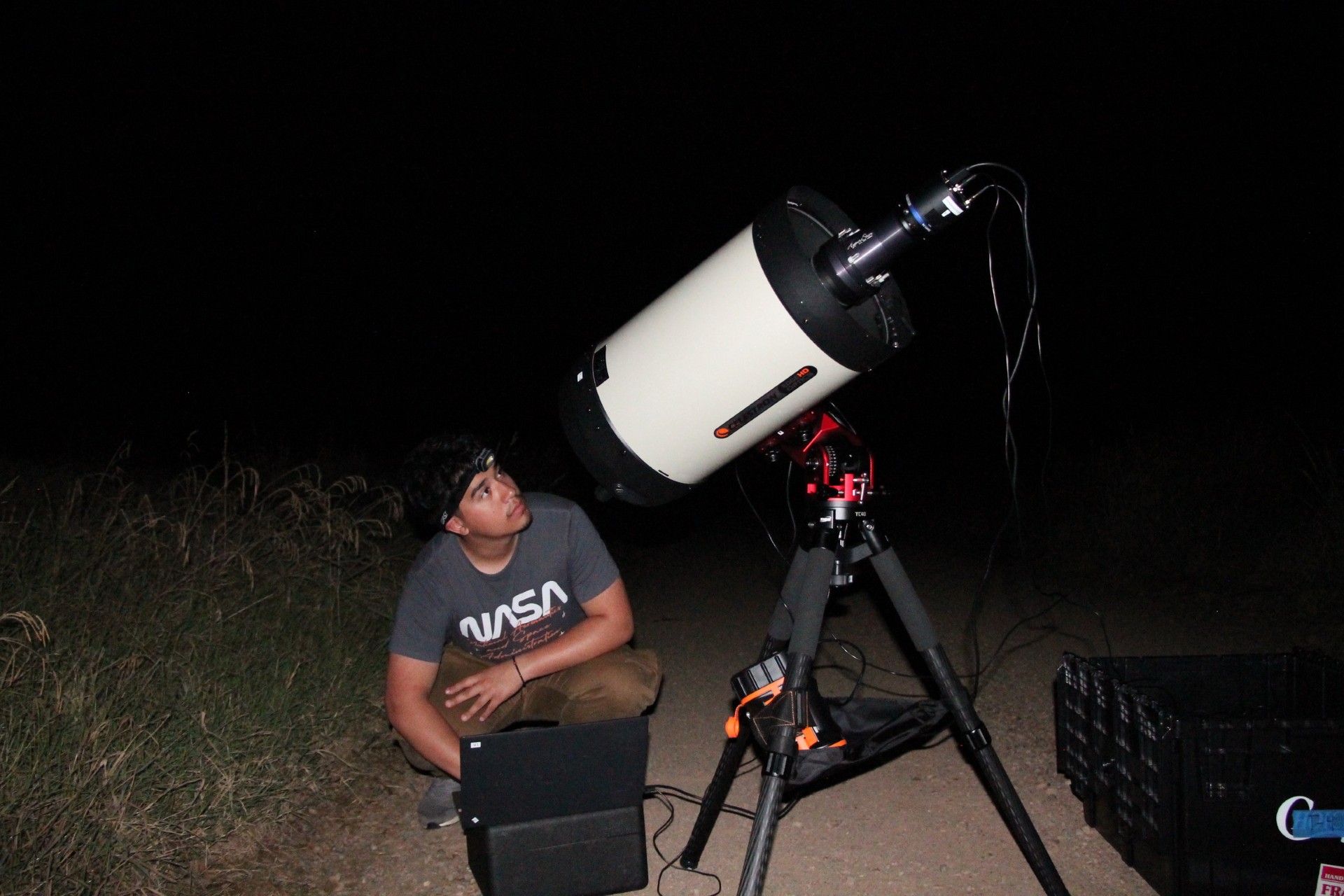
Our mission is to observe these occultations using telescopes outfitted with high-speed scientific astronomical cameras, and time the precise disappearance/reappearance of the star being occulted with GPS antennae, in order to best characterize the member bodies of our Solar System.
The Group currently consists of about 30 undergraduates who frequently, regularly, or intermittently participate in conducting occultation observations. All training on how to collect high-value scientific data is performed by students for students in-house, and our results are shared with the International Occultation Timing Association (IOTA), which packages them before shipping them off to the Jet Propulsion Laboratory (JPL) to update asteroid orbits with our measurements.
Our Operations
We operate in two primary modes: locally and on the road. Every night (if weather allows!) students in the Occultation Group configure telescopes on UVA Grounds, and observe between 30–40 potential stellar occultations. Many of these are occultations by asteroids with very uncertain orbits (most are only 1–2% likely to occur over Charlottesville), but when we detect one of these uncertain asteroids via occultation, we have definitively pinned down the orbit for that asteroid.
However, a specific "interesting" asteroid may only occult a handful of stars every year. An asteroid can be "interesting" for a number of reasons—either it is a target of a spacecraft mission, or it has a satellite companion, or maybe even rings! When these interesting asteroids occult a star, it is usually far from Charlottesville, and so we pack upwards of seven telescopes into our cars before driving to the nearest point along the shadow path! These research expeditions are some of the most exciting parts of occultation studies, and the Occultation Group has traveled all across the country (18 states) and the world (3 countries) to observe the highest-priority occultation events.
Collaboration
We work closely with amateur astronomers, professional observatories, and international research groups to coordinate observation campaigns and share data. These institutions include (but are not limited to): IOTA, the Southwest Research Institute (SwRI) and National Aeronautics and Space Administration (NASA) via the Lucy spacecraft, the United Arab Emirates Space Agency (UAESA), the University of the Western Cape (UWC), the Paris-based LuckyStar collaboration, and others.
Contact
For questions about our research, collaboration opportunities, or data access, please contact any member of the executive team. For questions about the website, or if you are an observer looking to be added to the website, please contact Andrey Moore at pvz5hs@virginia.edu.
Although this organization has members who are University of Virginia students and may have University employees associated or engaged in its activities and affairs, the organization is not a part of or an agency of the University. It is a separate and independent organization, which is responsible for and manages its own activities and affairs. The University does not direct, supervise or control the organization and is not responsible for the organization's contracts, acts or omissions.