Unlike the asteroids that the group typically observes, Pluto harbors an atmosphere. When Pluto occults a star, this atmosphere refracts the light of the star, resulting in a “central flash” in the middle of the occultation (see Figure). The strength and shape of this flash depend on the pressure and temperature of the atmosphere, and hence occultations are a way of studying Pluto’s atmosphere. Previous occultations of Pluto were observed in 2007 and 2018, so the occultation in 2022 provided an opportunity to see if Pluto’s atmosphere has changed over the past 15 years.
The central flash is most prominent at the chord that passes directly through the center of Pluto, and in this occultation the centerline passed near Katherine, Northern Territory, Australia. Liam and Becky joined a group from SwRI, led by Leslie Young and Eliot Young, at Katherine Rural Campus. Several students from a nearby university joined as well. During the days, the group explored the campus (lots of farm animals), enjoyed the Australian wildlife (many wallabies!), and went swimming in a beautiful nearby gorge. During the evenings, they practiced setting up the telescopes and observing Pluto.
On June 1, 2022, after several nights of practice, the teams set out to observe the occultation. Liam was on a team with Mike Skrutskie observing near Katherine, and Becky was on Anne Verbiscer’s team about an hour north of Katherine. It was hot and muggy, despite it being the early hours of the morning, and when Becky’s team started setting up the sky was cloudy. Fortunately, in the hour leading up to the occultation, the clouds began to clear, and the team was able to align the telescope, and finally get on field, in time to observe the event. They watched the star slowly dim, and then slowly reappear, as Pluto passed in front of the star, with the entire occultation lasting several minutes. At their site north of Katherine, Becky’s team was too far from the centerline to observe a noticeable central flash, but the team that Mike and Liam were on was more fortunate. They observed a bright central flash, over 2.5 times the brightness of the star. In addition, they observed with two telescopes - one 51-cm equipped with a red filter, and one 61-cm equipped with a blue filter.

Becky Williams pictured with Sky-Watcher 14-inch telescope.
In total, 15 telescopes were set up to observe Pluto: 8 near Katherine, 3 additional in Australia, and 4 in Indonesia. Analysis of the results, particularly the central flash observed by Liam and Mike’s team, suggest that Pluto’s haze opacity has changed from 2007 to 2022 and that Pluto’s atmosphere may be experiencing freeze-out (Young et al. 2023, DPS presentation). However, data analysis is still ongoing, and one mystery that remains is the narrowness of the central peak compared to models (Young & Young, 2025).
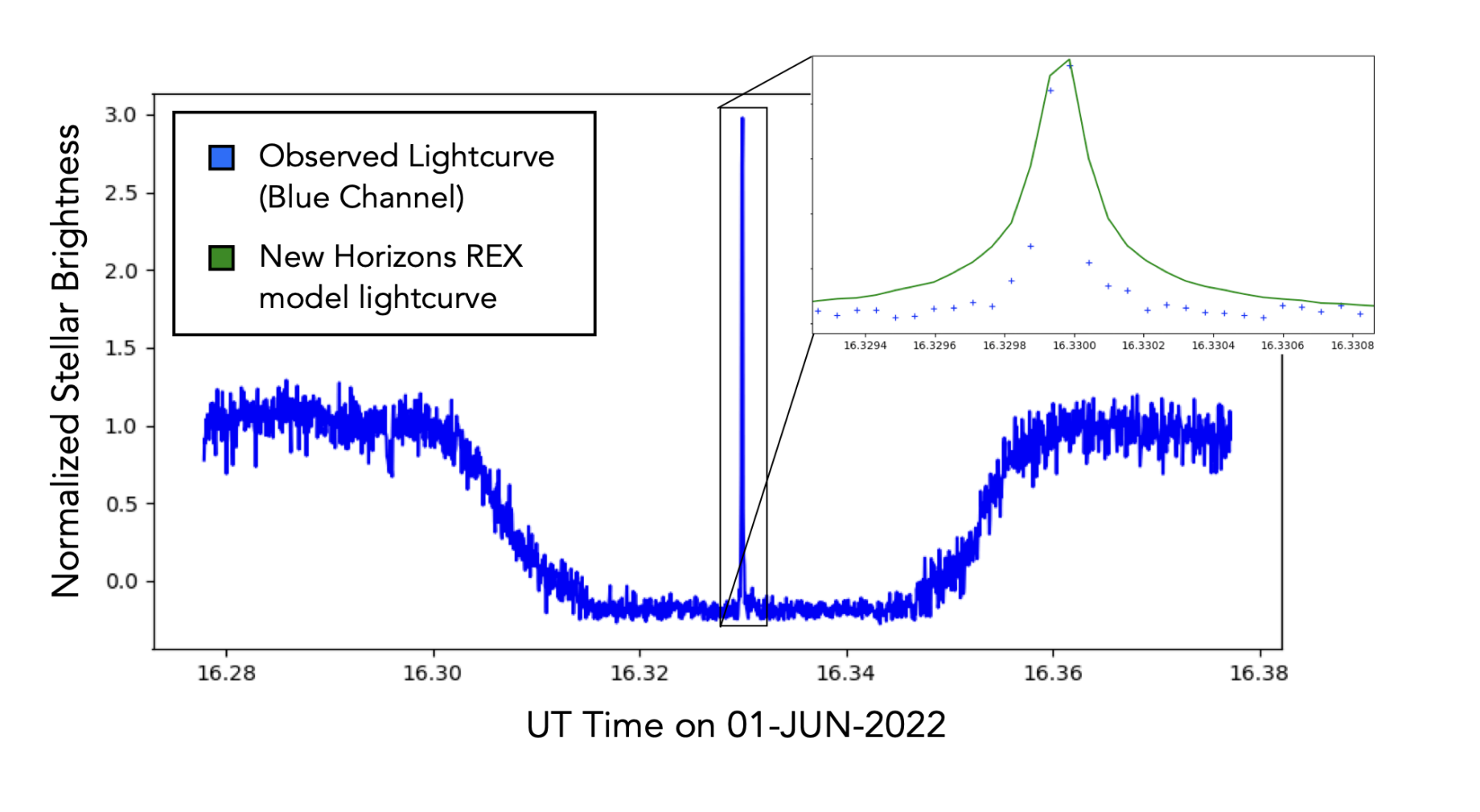
A central flash observed during the 01-JUN-2022 Pluto occultation (Young & Young, 2025).