On September 25th, 2025, four members of the Occultation Group packed their bags with tents, camping gear, a telescope, and just enough clothes to survive a week ahead on the tropical island of Kauaʻi, on the far west of the U.S. state of Hawaiʻi. We had a busy trip ahead of us, and excitement was tangible in the air! We were traveling into the central Pacific Ocean to observe a stellar occultation (transit of a star, much like an eclipse) by the fascinating object (50000) Quaoar, a dwarf planet in the outermost regions of the Solar System.
Quaoar is a dwarf planet roughly 1000 km in diameter—or 600 miles—which is about half the size of the ex-planet Pluto. Quaoar has at least one small moon, Weywot, but more interestingly, possesses a very unique set of rings. Rings are common around the larger planets, famously Saturn, but have only been shown to exist around three rocky bodies in the Solar System. In all three cases, especially in the case of Quaoar, these rings can only be detected by watching them pass in front of a star during an occultation, and looking for small diffraction effects in the data as the rings bend and interfere with the starlight. The rings are especially odd in that at least one of them exists beyond the Roche limit of Quaoar, which is the theoretical radius where rings should be able to stably exist around a planet (and recent occultation results suggest even another ring even farther out!). Observing and characterizing these rings was the objective of our expedition!
Usually, these diffraction effects are only observable with telescopes between 1-2 meters, and the largest telescope in our arsenal is 0.61 meters, which is not quite enough! To make up for the difference in telescope size (aperture), we planned on observing the occultation with as many telescopes as possible from the same location, combining their mirrors to act as one single large telescope! Of course, transporting many telescopes from Charlottesville is logistically and financially challenging, so we elected to ship only our largest 0.61 m telescope, and carried a smaller, 0.28 m telescope through checked baggage. To make up for the remaining aperture, we contacted the Kauaʻi Educational Association for Science and Astronomy (KEASA), a local astronomical society located on the western coast of the island, who operate an observatory complex on the Pacific Missile Range Facility (PMRF), a large Navy base near the towns of Waimea and Kekaha.
Located in the KEASA observatory complex on the PMRF are a series of telescopes: a 0.51 m Dobsonian, a 0.43 m Dall-Kirkham Cassegrain, and a 0.25 m Newtonian. A local member of the KEASA provided a mobile 0.36 m Dobsonian telescope as the final piece of the puzzle. Calculating the combined circular area of each of these telescopes brings our total aperture size to 1.01 meters, theoretically large enough to detect small wobbles in the starlight indicative of ring presence.
After a short layover in Denver, we slowly descended onto the Aloha State and excitedly hopped off the plane, grabbed our rental car, and ate some delicious saimin on the way to our first hotel: a mountaintop in the rainforest! Budgetary restraints meant our options were limited for most of the days of the trip, but camping permits were well within our budget and we booked a remote site at the top of the scenic Waimea Canyon. Just as our luck would have it, rain began to fall as we drove up the hazardous road and we had just enough time to set up our tents as the storm picked up. Our first night was long and wet, and one of the tents collapsed under the storm, soaking our poor vice president, who moved into the warm car for the remainder of the night.
The rain did not let up on day two, and the conditions of the roads had degraded to the point that we did not feel comfortable driving back to town, so we made the most of a cold and wet situation and explored the nature reserve! We trekked down to a river, following it to an enormous waterfall with large irrigation infrastructure. Everywhere we went, raw ginger grew out of the ground and was blossoming!
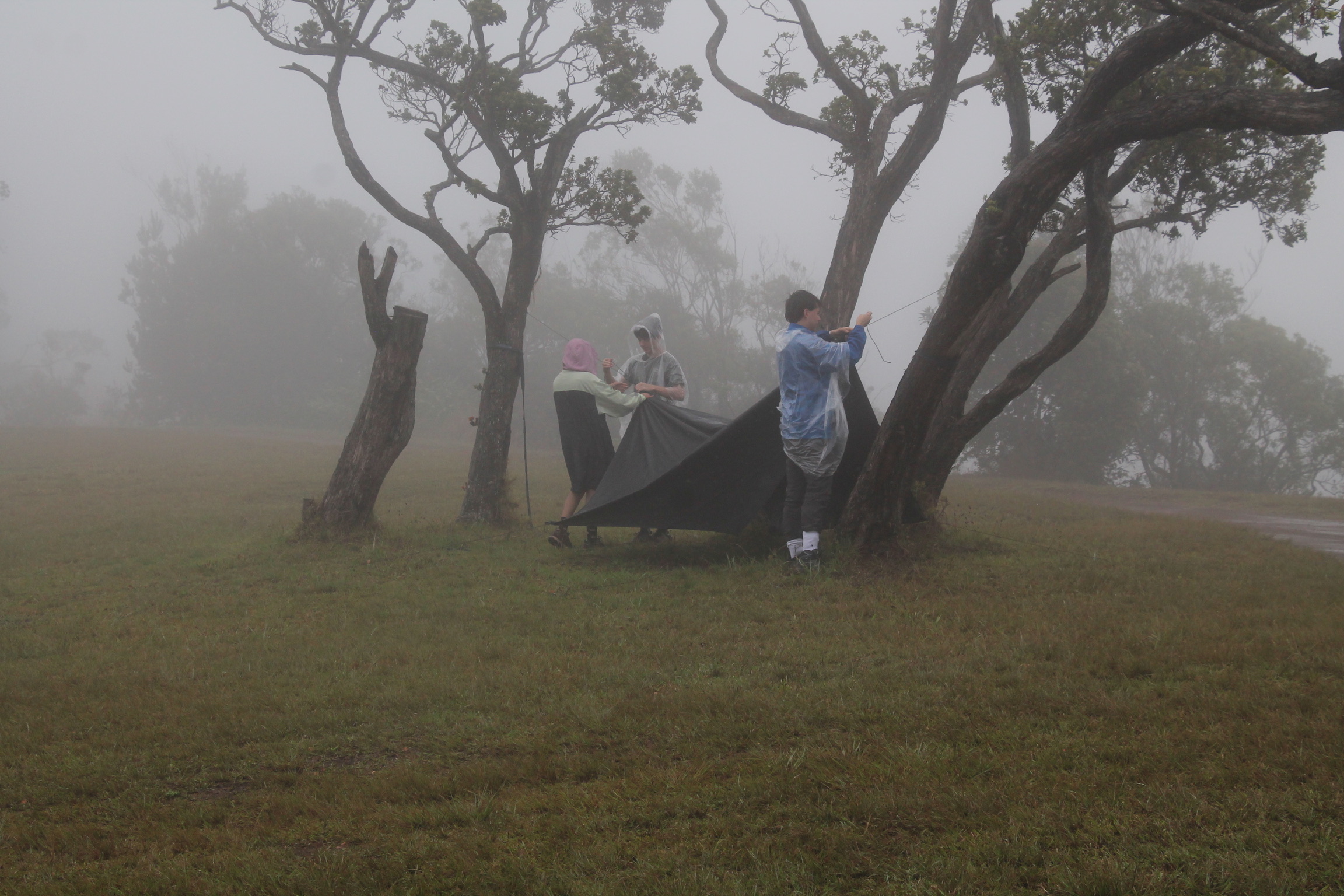
From left: Keya Garg, John DiPasquale, and Andrey Moore setup a hammock at Waikoali campsite. Credit: Phillip Oakey
That evening, as I settled in my tent under light rainfall, I drifted off to sleep—only to be shaken awake an hour later by excited whispering: the stars had come out! We spent the next few hours under one of the brightest night skies I have ever seen. I attached my DLSR camera with rubber bands to the telescope mount and took several long exposure pictures of the Milky Way. We eventually retired to our tents, since we had an early morning. Waking up at four a.m. is never easy, but the view made everything worth it. We were rising so early in the hopes of catching an occultation by a different asteroid to test all of our equipment, but were treated to something I never expected to see: stretching up to the planet Venus just before twilight was an exceptionally faint band of light– when I noticed it, I gasped. It was what is known as the zodiacal light, and is the result of sunlight reflecting off of the sparse interplanetary dust in the plane of the Solar System (kind of like a very faint version of Saturn’s rings, but on the scale of the Solar System). It can only be seen with the naked eye from the darkest sites on the surface of the Earth. Truly a treat!
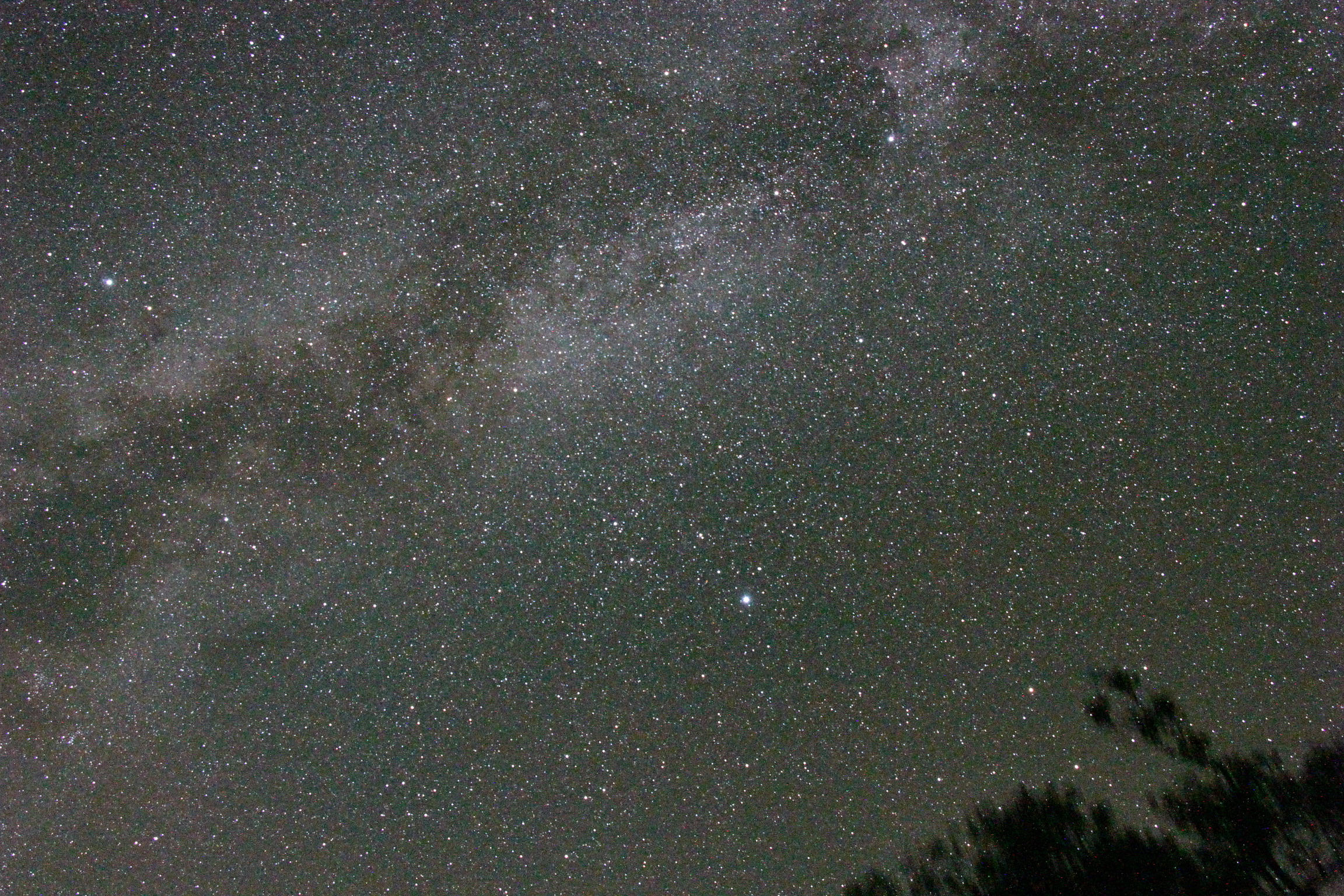
Milky Way seen from Waikoali campsite. Credit: Phillip Oakey
The Sun began to rise and we were finally able to see where we were camping- we had no idea we were on the edge of a cliff! About twenty feet away, the ground gave way to a three-hundred foot deep canyon. A magnificent sight. The rain would stay off all day and night, and the following day we were able to return to town. We continued rehearsal with our telescope at night.
The final two days were all business– we spent all day ensuring all of the equipment we would equip the KEASA telescopes with were in tip-top shape, batteries charged and GPSes calibrated. The need for electricity meant we were staying in an AirBnB for the final part of the trip. Once our host, Captain James Dire, arrived, we spent our penultimate afternoon on the PMRF familiarizing ourselves with the two telescopes we could access and that were compatible with our cameras and computers. Everything was going smoothly!
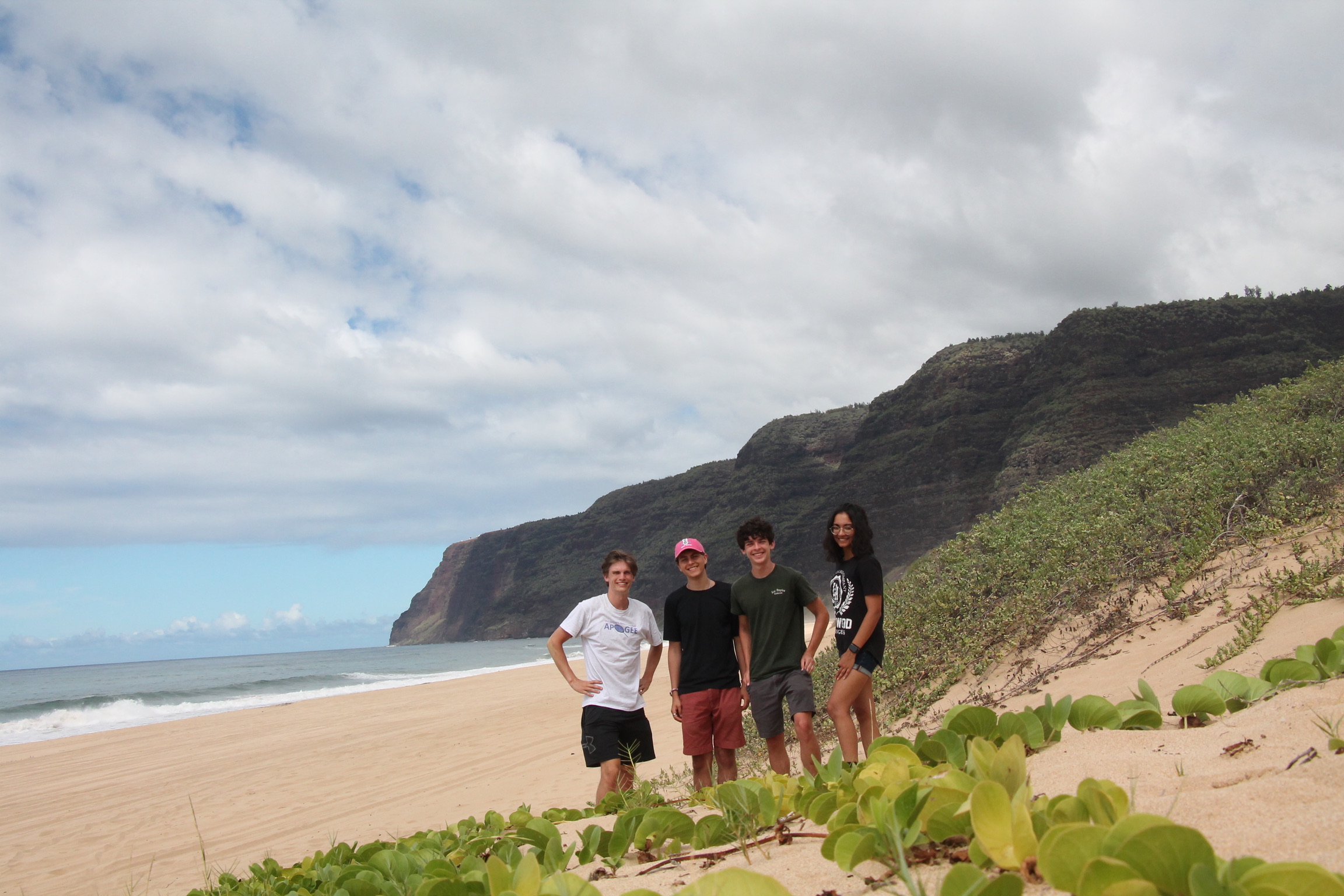
From left: Phillip Oakey, Andrey Moore, John DiPasquale, Keya Garg at Polihale state park. Credit: Phillip Oakey
The next night was the big day! The occultation was scheduled to occur at approximately 8:30 p.m. local time; the four telescopes we already worked with were good to go, and we had just over three hours to configure the other two telescopes to run in time. These new two were enigmatic– they were unmotorized, which meant that their owners, local KEASA members, would have to move the behemoth telescopes by hand! Keeping an eye on a computer screen, identifying a tiny, faint target star, and pushing a twelve-foot telescope by hand every thirty seconds is a monumental task, especially for a first-time occultist. Even more troublesome was that one of the telescopes didn’t seem to come into focus with our camera installed, but Andrey Moore was able to save the day with some quick MacGyver-style thinking, rotating the placement of each camera+computer+timer system between the telescopes just twenty minutes before we started to capture our data.
Because Quaoar is so far away, it moves much slower in its orbit and will typically occult a star for around 60-80 seconds (also due to its enormous size), which is much longer than small, nearby asteroids, which typically will occult for about a second or two at most. However, the relative motion of Earth and Quaoar meant that Quaoar was approaching retrograde, meaning the two planets were moving in the same direction, which means that occultations during this period could be three or four times as long as normal. In this case, the maximum predicted duration for the occultation was about three minutes! This made this particular occultation particularly exciting for ring science, since the rings would be passing in front of the star for three times as long as well, and we could gather more signal in our detector. Because of how far our the rings are, we would need to record for fifteen minutes on either side of the main body occultation to make sure we captured any interesting event.
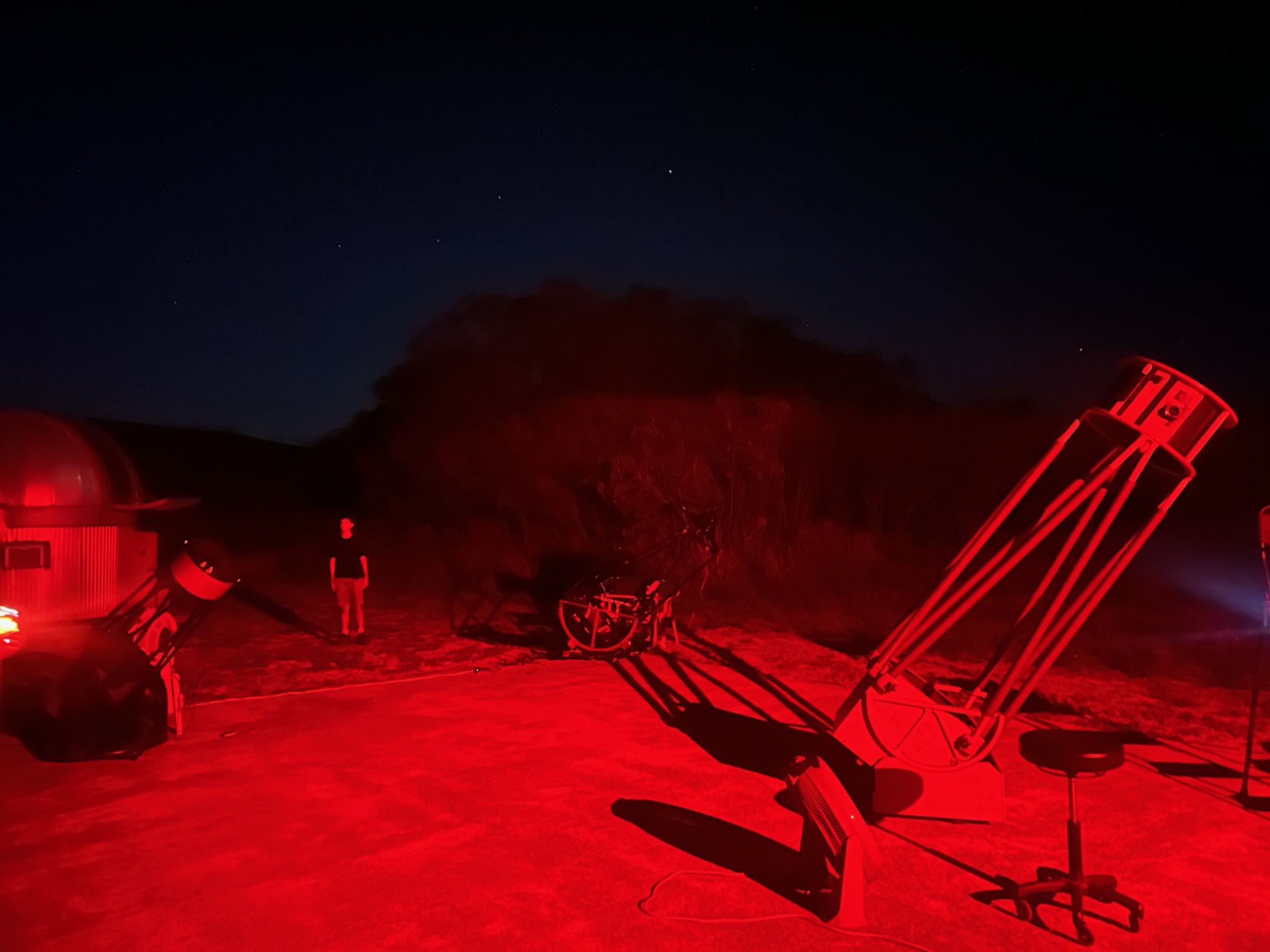
From left: 10 inch telescope dome, 14 inch unmotorized Dobsonian, Andrey Moore, 24 inch UVA Dobsonian, 20 inch unmotorized Dobsonian on event night
Sure enough, all six telescopes were prepped and ready for the occultation just in time, and each team (with some close calls) managed to observe for the full thirty minutes– and everybody saw the occultation! In order to say anything definitive about the rings, we will need to bin and stack the data from each telescope on top of one another, but we are interested to see what the data show! We look forward to updating this article when more information is available. We would like to share our appreciation to the KEASA and PMRF for their facilities support in this expedition, the Outdoors Club at UVA for camping supplies, and the Parent’s Program and SAF funding for financial support for travel and equipment expenses.
Clear skies,
Teddy Oakey
President, Occultation Group