 The Occultation Group at UVA
On May 28th, 2026, two undergraduate members of the Occultation Group traveled to Christopher Newport University in Newport News, Virginia, to present scientific results from a stellar occultation. They were participating in the 104th annual meeting of the Virginia Academy of Sciences (VAS), and brought along with them a poster detailing the background, preparation, expedition, and analysis for the observation of a stellar occultation by (623) Chimaera, an asteroid which is selected for spacecraft fly-by in the early 2030s. The occultation occurred on October 21st, 2025, and a link to a news story and video report which covers this occultation in detail can be found here.
The students, Diego Gomez and Colin Surovell, are two first-years at the University of Virginia and experienced members of the Occultation Group. Both have worked hard to obtain the data for this occultation and to analyze it. Diego Gomez applied himself to understanding the lightcurves which were created from each telescope’s data. Lightcurves are graphical representations of the target star’s brightness before, during, and after the occultation. Gomez had this to say about the analysis experience: “I definitely learned how, even though we can plug our data into external tools, we were able to do it ourselves and actually see the shape of the asteroid from just the lightcurves. I feel like, since you can do that, it’s really accessible science for anyone to do. Pick a target, observe it, and plot it in this way–it’s an incredibly inclusive science.” Colin Surovell felt that the experience helped cement many of the scientific concepts which he uses in the research group. “I really enjoyed getting to show people our research. Putting together the poster was really helpful to me specifically; being able to put everything into a format which is so presentable helped give me a deeper understanding of the work that we do.”
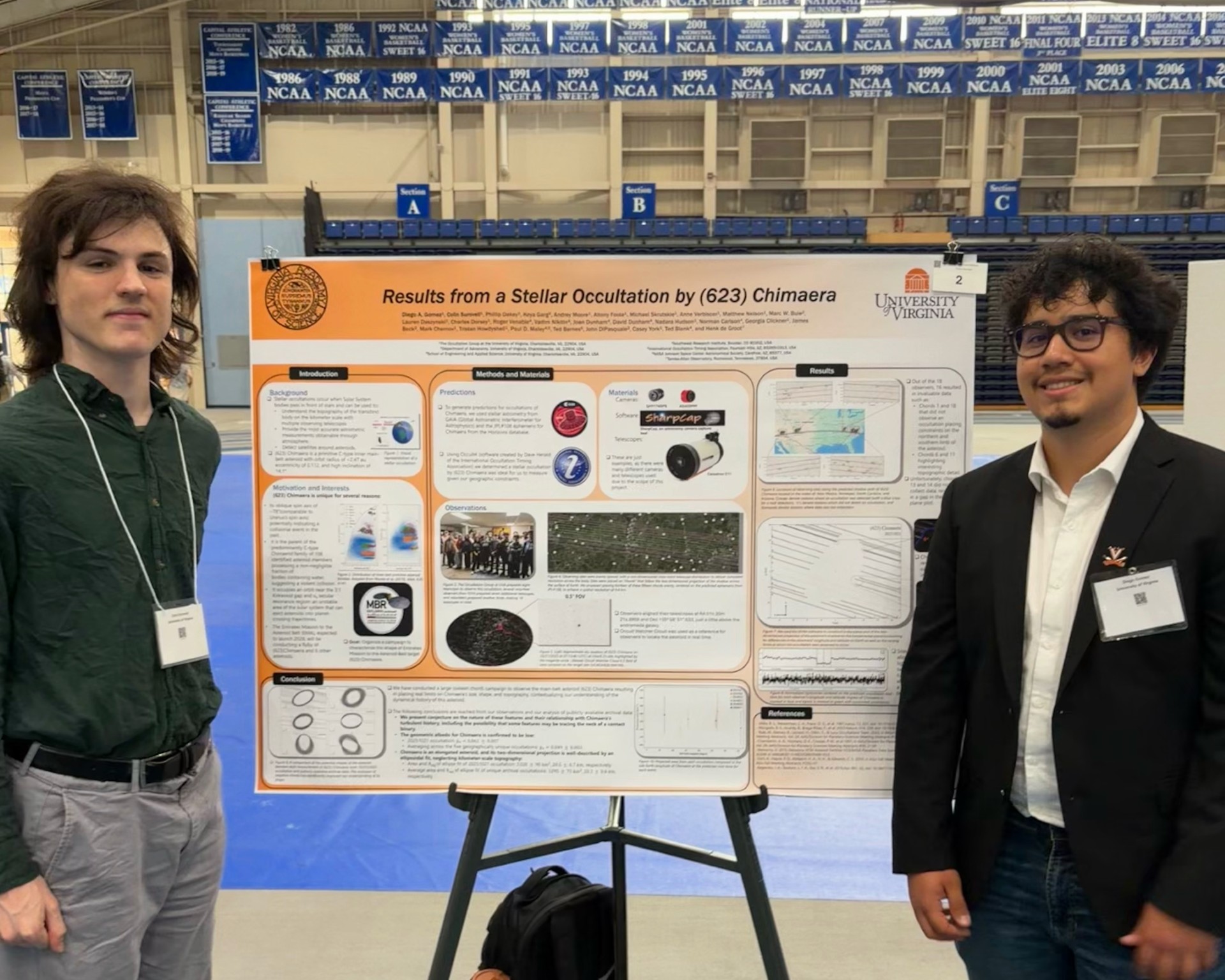
From left: Colin Surovell and Diego Gomez presenting their poster at VAS.
The conference itself was particularly exciting. Dozens of posters lined the tables of a gymnasium at Christopher Newport University, each bringing their own scientific story to the conference. “Presenting our work was satisfying–there were lots of people who worked in the field of astronomy and lots who worked in other disciplines, and it was really enjoyable to see that we were able to explain our research to people who didn’t have the specific background knowledge that we have,” reported Surovell. These results are being prepared into a scientific manuscript which is planned to be submitted to a peer-reviewed journal within the coming weeks. We are proud of our observers for representing our group so well at VAS!
Clear skies,
Teddy Oakey
President, Class of 2026